Best Places to Live in the Northeast in 2026
The Northeast gets written off by affordability-focused relocators more often than it deserves. Yes, New York City and Boston are expensive. But the Northeast spans 11 states and thousands of communities, and its best mid-sized cities offer something genuinely rare: density of culture, history, and economic opportunity at price points that rival the Midwest.
Pittsburgh has a median home price near $250,000 and an unemployment rate under 3.5%. Philadelphia remains one of the most affordable major cities in the country relative to the career opportunities it supports. Providence and Portland, Maine draw people from expensive coastal metros who want walkable city life without the price tag of Boston or New York. And Albany, Saratoga Springs, and Burlington anchor a tier of smaller Northeast cities that consistently rank at the top of quality-of-life lists without making the front pages.
This article covers six cities that represent the honest range of what the Northeast offers in 2026 — from genuinely budget-friendly to premium but worth it. For each city, you can look up specific ZIP codes at ZipCodePlus.com to compare median household income, median home value, median rent, and sales tax rates at the neighborhood level.
What to Expect from the Northeast
Before diving into individual cities, it helps to set accurate expectations. The Northeast differs from the Midwest and Southeast in a few consistent ways:
| Factor | Northeast Reality |
|---|---|
| Housing costs | Higher than national average in most markets, but Pittsburgh and Philadelphia are genuine exceptions |
| Public transit | Better than almost anywhere else in the U.S., especially near major metros |
| Climate | Four real seasons, including genuine winters in most of the region |
| Job market depth | Among the strongest in the country for finance, healthcare, education, and tech |
| Cost of living overall | Varies sharply by city — Pittsburgh is below the national average; Boston is 58% above it |
The Northeast rewards buyers and renters who research at the ZIP code level rather than relying on state-level impressions. A ZIP code in suburban Connecticut near a train line to Manhattan lives in a completely different economic universe than a ZIP code two hours north.
Pittsburgh, Pennsylvania
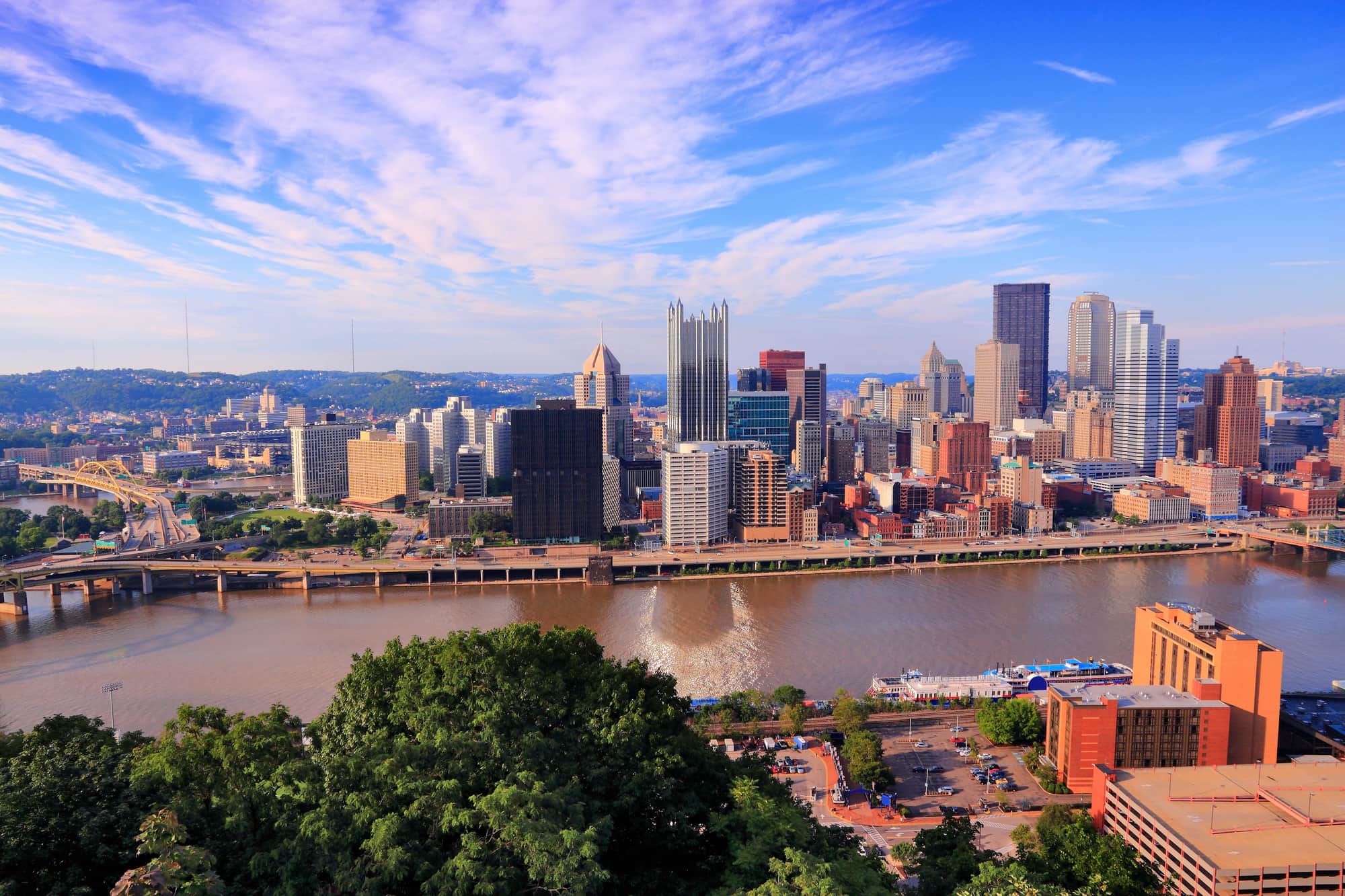
Pittsburgh may be the most underrated city in the country for people relocating from high-cost metros. It has quietly reinvented itself over four decades from a steel town into a leading center for healthcare, technology, and education — anchored by the University of Pittsburgh Medical Center (UPMC), Carnegie Mellon University, and the University of Pittsburgh. Forbes has repeatedly recognized Pittsburgh as one of the best cities in the country for job seekers and career growth.
The housing market is exceptional by Northeast standards. The median sale price in Pittsburgh was approximately $242,000 in Q3 2025, up 2.9% year-over-year.1 Pittsburgh is one of the only major U.S. cities where the monthly cost of buying a starter home is cheaper than renting — a reversal of the pattern in most American metros.2 The overall cost of living runs approximately 3% below the national average, with housing costs about 11% lower than the norm.3
The unemployment rate sits at a low 3.4%, well below the national average, reflecting the stability that comes from an “Eds and Meds” economy that does not swing with manufacturing cycles the way Pittsburgh once did.2 The metro area also hosts Fortune 500 companies including PNC Bank, U.S. Steel, and Alcoa.
The trade-offs are real. Pittsburgh’s street grid — a product of three rivers meeting at irregular angles — is famously difficult to navigate, and the public transit system is limited compared to Philadelphia or Boston. Winters bring meaningful snow, averaging around 28 inches per year.
Browse ZIP codes in Pennsylvania ->. Downtown Pittsburgh is in ZIP code 15222. The walkable Squirrel Hill neighborhood is in ZIP code 15217.
Best fit for: Young professionals in healthcare and tech; families seeking top-tier medical access and affordable homeownership; buyers priced out of Philadelphia or the mid-Atlantic corridor.
Philadelphia, Pennsylvania
Philadelphia is the Northeast’s great affordability story at scale. As a major metro — the sixth-largest city in the country by population — it supports one of the deepest job markets on the East Coast, spanning healthcare, education, finance, and a growing tech sector anchored by companies like Comcast and a dense cluster of university and hospital employers. It also has more history per square mile than almost anywhere in the country.
The median home price in Philadelphia hovers near $250,000, dramatically below what comparable urban density costs in Boston, New York, or Washington.4 That combination — major-city career infrastructure at mid-sized city housing prices — is what draws buyers who want genuine upward mobility without coastal price tags. Neighborhoods like Fishtown, East Passyunk, and Manayunk have become genuine destinations, not just affordable alternatives.
Philadelphia also benefits from one of the most developed public transit systems in the country, with subway, trolley, and regional rail lines connecting the city and its suburbs in ways that reduce car dependency significantly.
The honest caveats: crime rates vary sharply by neighborhood and warrant careful ZIP-level research before committing to a specific area. Some city neighborhoods have seen significant investment and revitalization; others have not. Philadelphia’s property tax structure also differs from many cities and is worth understanding before buying.
Browse ZIP codes in Pennsylvania ->. Center City Philadelphia is in ZIP code 19103. The Fishtown neighborhood is in ZIP code 19125.
Best fit for: Buyers and renters who want major-city scale, deep job markets, and historic urban neighborhoods at prices that still allow wealth-building; commuters who need East Coast connectivity.
Portland, Maine
Portland, Maine ranks among the most desirable small cities in the country, and the data backs up the reputation. U.S. News ranked it among the top 10 relocation destinations nationally in its 2025 research, and it placed second overall in RentCafe’s 2026 livability analysis of U.S. metros — citing its quality of life, community character, and coastal setting.5
The honest reality is that Portland has become genuinely expensive for its size. The median home value in Portland was approximately $576,000 as of early 2026 according to Zillow, with median rents around $1,950 per month.6 That pricing reflects intense demand — from remote workers fleeing Boston, from lifestyle-motivated buyers, and from a city that built a national food and arts reputation well beyond its roughly 70,000-person population.
What Portland delivers for that price is substantial: a walkable, compact city with a world-class restaurant scene, immediate access to ocean and mountains, a genuine arts community, and a pace of life that stands apart from larger Northeast metros. The Casco Bay coastline, Cape Elizabeth, and Acadia National Park (two hours north) give Portland an outdoor recreation context that no Midwest city can match.
The surrounding region — Lewiston-Auburn, Biddeford, and the broader southern Maine corridor — offers more accessible price points while still putting Portland’s amenities within reasonable range. Buyers who stretch their geographic search beyond the city proper will find meaningfully different numbers.
Browse ZIP codes in Maine ->. Downtown Portland is in ZIP code 04101. The East End neighborhood is in ZIP code 04101.
Best fit for: Remote workers and lifestyle-motivated buyers who prioritize outdoor access, food culture, and small-city quality of life; buyers relocating from Boston or New York who want similar amenities at a lower intensity.
Providence, Rhode Island
Providence sits at the intersection of two things that rarely overlap: a genuine college-town creative culture and reasonable proximity to one of the best job markets in the country. Brown University and the Rhode Island School of Design (RISD) have shaped Providence into a city with a disproportionate arts, food, and design presence for its size. It is also 50 miles from Boston — close enough to commute to, or to access for career purposes, without paying Boston housing prices.
Housing in Providence remains more accessible than Portland or Boston. The city’s diverse stock of older triple-deckers, colonial-era neighborhoods like College Hill, and revitalized areas like the Jewelry District and Eagle Square give buyers and renters real options at a range of price points.
Rhode Island’s sales tax rate of 7% is among the highest in the region, which is worth factoring into cost-of-living calculations. But for buyers who want a walkable, culturally rich city with coastal access, professional sports proximity, and Boston connectivity, Providence consistently earns consideration.
Browse ZIP codes in Rhode Island ->. Downtown Providence is in ZIP code 02903. College Hill is in ZIP code 02906.
Best fit for: Young professionals and creatives who want a Boston-adjacent city without Boston pricing; remote workers who value walkability and arts access; buyers seeking coastal New England character at mid-sized city scale.
Albany and Saratoga Springs, New York
The Capital Region of New York — anchored by Albany, Schenectady, Troy, and the resort destination of Saratoga Springs — is among the most overlooked relocation areas in the Northeast. Albany’s role as the state capital means a stable base of government, healthcare, and university employment that buffers the local economy from private-sector swings. The median home price in Albany hovers near $180,000, making it one of the most affordable cities of its size in the entire Northeast.7
Saratoga Springs sits 35 miles north of Albany and occupies a different niche entirely. Known for the Saratoga Race Course, the Saratoga Performing Arts Center, and a walkable downtown with exceptional restaurants and boutiques, it delivers a quality of life that a city of 30,000 typically cannot sustain. The median home price is higher than Albany’s — typically in the $400,000 to $500,000 range — but it represents genuine value relative to the lifestyle it provides.
The region’s location puts it within driving range of the Adirondacks, the Catskills, Vermont ski areas, and Boston or New York City for occasional visits. For buyers who want four-season outdoor recreation, a real downtown, and Northeast career access without coastal pricing, the Capital Region rewards serious investigation.
Browse ZIP codes in New York ->. Downtown Albany is in ZIP code 12207. Downtown Saratoga Springs is in ZIP code 12866.
Best fit for: State government employees; buyers seeking maximum affordability in a Northeast city with real culture; outdoor enthusiasts who want Adirondack access; families who want small-city stability with regional connectivity.
Burlington, Vermont
Burlington is the smallest city on this list — about 45,000 residents — and also the most consistent performer on quality-of-life rankings for its size. Situated on the eastern shore of Lake Champlain with the Green Mountains immediately to the east, Burlington’s natural setting alone would distinguish it. The presence of the University of Vermont and Champlain College keeps the city younger and more economically dynamic than its size would otherwise suggest.
The median home price in Burlington sits around $350,000 — higher than Pittsburgh or Albany, but moderate by Northeast coastal standards and justified by the lifestyle the city delivers.8 The food scene, the Church Street pedestrian marketplace, and the outdoor recreation access (hiking, skiing, lake kayaking) create a quality-of-life density that few cities of comparable size can match anywhere in the country.
Burlington’s honest limitations are worth naming: the job market is smaller and more concentrated than any other city on this list, centered on healthcare, education, and state government. Remote workers are the best-positioned candidates, followed by healthcare professionals (the University of Vermont Medical Center is the city’s anchor employer). Housing inventory remains tight, which means buyers need to move quickly in a competitive market.
Browse ZIP codes in Vermont ->. Downtown Burlington is in ZIP code 05401.
Best fit for: Remote workers who prioritize outdoor access and small-city quality of life; healthcare professionals; buyers willing to trade job market depth for exceptional lifestyle in a compact, walkable city.
Northeast Comparison at a Glance
| City | State | Approx. Median Home Price | Relative Cost of Living |
|---|---|---|---|
| Albany | NY | ~$180K | Below national avg |
| Pittsburgh | PA | ~$242K | ~3% below national avg |
| Philadelphia | PA | ~$250K | Near national avg |
| Burlington | VT | ~$350K | Above national avg |
| Providence | RI | ~$350K | Near national avg |
| Portland | ME | ~$576K | ~14% above national avg |
Sources: Redfin, Zillow, Salary.com, U.S. News Best Places to Live 2025-2026.
Using ZIP Code Data to Compare Northeast Neighborhoods
The Northeast is a region where ZIP-level data matters more than almost anywhere else. Two ZIP codes in the same city can have median home values that differ by $300,000. Sales tax rates vary meaningfully between states — New Hampshire has no sales tax, while Rhode Island and Maine carry rates of 6-7%. Climate zones shift from the relatively mild Mid-Atlantic to the genuinely cold continental zones of upstate New York and northern New England.
Before committing to any Northeast city, run the specific ZIP codes you are considering through ZipCodePlus.com. The housing card will show median home value and median rent. The taxes card will show the combined sales tax rate. And the climate card will confirm the USDA hardiness zone — relevant if you are comparing, say, a ZIP in Philadelphia (Zone 7a) to one in Burlington (Zone 5b), where the winters are a full two hardiness zones colder.
For more detail on how to use that data together, see How to Use Climate Data When Choosing Where to Live and How to Compare Cost of Living Between Two Cities. For the companion regional guides, see Best Places to Live in the Southeast 2026 and Best Places to Live in the Midwest 2026.
Related Reading
- Most Affordable Cities to Buy a Home in 2026
- Average Rent by State 2026
- Best Places to Live for Young Professionals in 2026
- Best Places to Live in the Midwest 2026
Sources
Page last updated: April 2026. Housing data reflects available figures from early 2026. Median prices vary by source and month. Always verify current listings and neighborhood conditions before making a relocation decision.
Footnotes
-
Steadily — ‘Pittsburgh Real Estate Market Overview 2026,’ January 2026. https://www.steadily.com/blog/pittsburgh-real-estate-market ↩
-
Extra Space Storage — ‘Is Pittsburgh a Good Place to Live? 16 Pros and Cons of Moving (2026 Guide).’ https://www.extraspace.com/blog/city-guides/pros-and-cons-of-living-in-pittsburgh/ ↩ ↩2
-
Salary.com — ‘Cost of Living in Pittsburgh, PA 2026.’ https://www.salary.com/research/cost-of-living/pittsburgh-pa ↩
-
The Places to Live — ‘10 Best Cities to Live in the Northeast,’ January 2026. https://theplacestolive.com/10-best-cities-to-live-in-the-northeast/ ↩
-
The MortgagePoint — ‘New Rankings Reveal Most Livable U.S. Metros for 2026,’ December 2025. https://themortgagepoint.com/2025/12/24/new-rankings-reveal-most-livable-u-s-metros-for-2026/ ↩
-
Zillow / Zumper — Portland, ME housing and rent data, February 2026. https://www.zillow.com/home-values/40415/portland-me/ and https://www.zumper.com/rent-research/portland-me ↩
-
The Places to Live — ‘10 Best Cities to Live in the Northeast,’ January 2026. https://theplacestolive.com/10-best-cities-to-live-in-the-northeast/ ↩
-
The Places to Live — ‘10 Best Cities to Live in the Northeast,’ January 2026. https://theplacestolive.com/10-best-cities-to-live-in-the-northeast/ ↩